

Steel mills and metal processing industries require high-quality products due to high temperatures and critical applications. With KLINGER’s certified sealing products, it is possible to reliably seal even the most demanding applications. Our products are designed to meet the ever-changing needs of the metal industry, where customers demand custom solutions that align with their specific needs and requirements. KLINGER offers unique solutions for complex problems facing the metal processing industry today, such as high-pressure and high-temperature environments. Our on-site technical and engineering support makes it easier for customers to find the best solution for their needs.
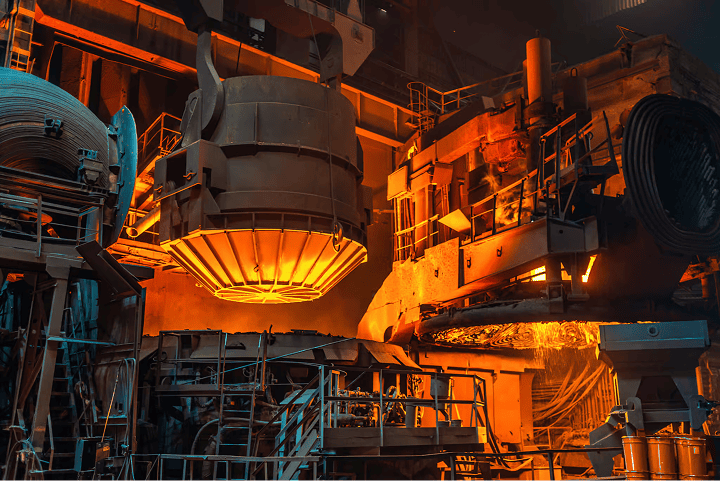
The steel industry is at a turning point: while conventional steel production depends on fossil fuels such as coal and coke, green steel production offers a sustainable alternative through the use of renewable energy sources and innovative technologies. In both processes, KLINGER makes a decisive contribution to process reliability, minimizes downtime, and reduces leakage.
Traditional steel production processes
Traditional steel production processes, such as Basic Oxygen Steelmaking (BOS) and the use of blast furnaces, use coal and coke to reduce iron ore. This produces large amounts of CO₂ emissions – the steel industry accounts for approximately 7% of global greenhouse gas emissions. In addition to emissions, this process produces significant waste products, such as slag, and strains natural resources through mining and energy consumption.
Green steel production
In contrast, green steel production is based on renewable energy and innovative processes such as the Hydrogen Direct Reduced Iron (H2-DRI) process. In this process, green hydrogen, generated with 100% renewable energy, is used to reduce iron ore, with only water vapor produced as a by-product. The use of electric arc furnaces (EAF) also enables the processing of recycled steel scrap, making fossil fuels redundant. This process reduces CO₂ emissions by up to 95% compared to conventional production.
Comparison of processes
| Feature | Conventional production | Green steel production |
|---|---|---|
| Reducing agent | Coal/coke | Green hydrogen |
| CO₂ emissions | High | Up to 95% less |
| Raw material use | Iron ore | Recycled steel scrap |
| Energy source | Fossil fuels | Renewable energies |
The transition to green steel is not only a contribution to climate protection, but also an opportunity for innovation and competitiveness. With a focus on sustainability and the circular economy, green steel forms the basis for a climate-neutral future. KLINGER provides solutions and services to the steel industry to make processes more efficient, prevent unplanned downtime, and meet the highest safety standards. This makes KLINGER a reliable partner for the future of steel production – regardless of the chosen production process.