
Expansion joints
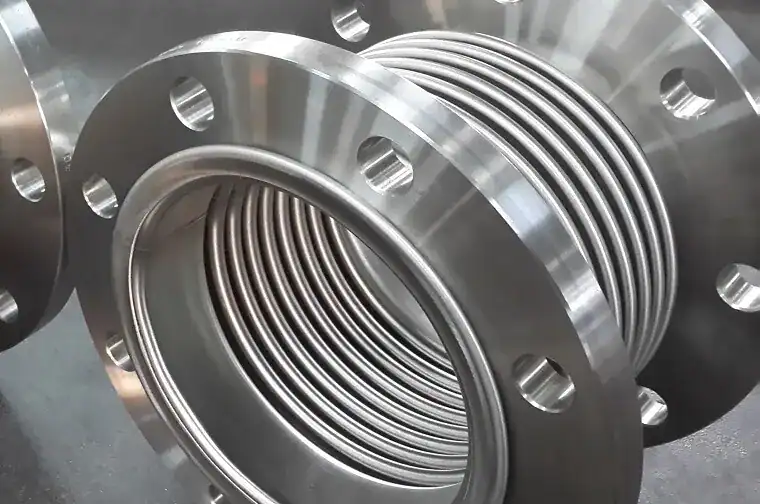
Temperature differences, pressure fluctuations, and vibrations constantly place stress on piping systems. Without the right expansion joint, pipes can deform, flange connections can leak, and pumps or heat exchangers can be damaged.
Expansion joints (also called compensators) absorb these movements and ensure a safe, reliable, and stress-free installation.
KLINGER Belgium supplies a wide range of high-quality expansion joints from renowned European manufacturers: from rubber and PTFE expansion joints to metallic and fabric expansion joints. Standard versions are available quickly; custom solutions are designed according to your specifications. All expansion joints are supplied with various European certificates and attestations.
PTFE expansion joints
Chemically inert PTFE expansion joints that absorb movements and vibrations in pipelines carrying aggressive media, acids, and alkalis.
Rubber expansion joints
Elastic rubber expansion joints that dampen vibrations, noise, and misalignments in water, wastewater, and pumping pipelines.
Metal expansion joints
Expansion joints with a metal bellows that absorb axial, lateral, and angular movements at high temperature and pressure, including under vacuum.
Fabric expansion joints
Flexible expansion joints made of technical fabric for ducts with hot gases, flue gases, and air at low pressure and high expansion.
Why do you need an expansion joint?
Due to temperature changes, metal pipes expand or contract. This linear expansion is greater than often thought: a 50-meter steel pipe expands by as much as 60 mm with a temperature difference of 100 °C.
When pipes have insufficient freedom of movement, high reaction forces arise on pipes, flanges, pumps, valves, and other connected equipment. As a result, connected systems can be damaged or even torn loose. Also, mechanical vibrations from pumps, compressors, motors, and other installations, as well as media-induced vibrations due to pulsating flow, seriously affect pipes and flange connections.
Without the right expansion joint, you risk:
- damage to pipes and equipment
- leaks at flange connections
- unplanned production downtime
- exposure to hazardous media
- environmental damage
- dangerous situations for employees and the environment
With the right expansion joint in the right place, you limit stresses in the piping system, extend the lifespan of installations, and increase operational reliability.
Our range of expansion joints
Every application requires a different type of expansion joint. Medium, pressure, temperature, and the type of movement together determine the right choice. KLINGER Belgium offers four material groups, each with a wide range of designs.
1. Rubber expansion joints
The rubber expansion joint is among the most commonly used solutions for reducing and compensating for vibrations, noise, pipe expansion and minor misalignments. These rubber bellows expansion joints are also easy to install.
Versions:
- with steel or stainless steel flanges according to DIN or ANSI, for a reliable flange connection
- rubber bellows in EPDM, NBR, Hypalon, and FPM, among others, tailored to the medium
- with PTFE lining or vacuum support ring
- with tie rods, hinges, flame covers, and protective outer sleeves
2. PTFE expansion joints
For chemical applications, the PTFE expansion joint is frequently the solution and a full-fledged alternative to rubber expansion joints. They are quickly assembled according to customer specifications.
The most common PTFE expansion joints have 2, 3, or 5 convolutions and are equipped with floating flanges with limiters. In our standard range, they are supplied with DIN or ANSI flanges.
With standard PTFE expansion joints with 2, 3, or 5 convolutions, the pressure resistance decreases rapidly as temperature rises. Our product specialists would be happy to advise you on this.
3. Metallic expansion joints
Metallic expansion joints are mostly used in the (petro)chemical industry, power plants, and shipbuilding. They absorb thermal expansions, reduce vibrations, and ensure stress-free setups in piping systems for a wide variety of process techniques.
KLINGER metallic expansion joints are designed, produced, and tested according to the criteria of the Expansion Joint Manufacturers Association, or EJMA standards for short.
The most common types of metallic expansion joints:
- Single expansion joints: simple designs with one bellows element for absorbing axial, lateral, and angular movements.
- Universal expansion joints: equipped with two bellows elements and suitable for absorbing large axial and lateral movements at lower pressure classes.
- Tied expansion joints: one or two bellows elements and at least two tie rods. The number of tie rods depends, among other things, on diameter and pressure class. Suitable for small lateral and axial movements.
- Hinged expansion joints: one or two bellows elements and multiple hinges, for absorbing small angular movements in one plane. A combination of two or three expansion joints can absorb large axial movements.
- Gimbal expansion joints: one bellows element and a gimbal construction, for absorbing small angular movements in any plane.
More information: KLINGER Turkey and KLINGER Politeknik.
4. Fabric expansion joints
The fabric expansion joint is mostly used for the transport of (hot) air and dust at lower pressure. Fabric expansion joints are always designed and produced according to customer specifications and are available in a wide variety of shapes, constructions, materials, and connections.
The most common types:
- U-type and belt-type expansion joints: the most economical standard types for the most common applications in round and rectangular ducts.
- U-type expansion joint for overpressure and vacuum: particularly for rectangular ducts, also available in special corner designs.
- Multi-layer shaped expansion joint with intermediate flanges and tie rods: necessary for large, rectangular, or round ducts, especially with large axial movements. The intermediate flanges can be designed with tie bolts or special suspensions.
- Belt-type expansion joint for overpressure and vacuum: for rectangular expansion joints, the corners must be rounded with the flange height of the corner profile.
Why choose expansion joints from KLINGER?
- Reliable link: high quality from renowned European manufacturers, for maximum operational reliability
- Custom expansion joints: from standard versions to fully customized solutions, designed and produced according to your specifications
- Expert advice: specialists with years of experience in various industrial sectors and their specific needs
- Support and guidance in every form: from on-site measurement to installation supervision
- Certified quality: delivery including various European certificates and attestations
- Sustainable forward-thinking: preference for long-term solutions, driven by a great sense of responsibility
KLINGER expansion joints are successfully used for a wide variety of applications. Years of intense cooperation with our customers from various industrial sectors have led to excellent knowledge of the various markets. Knowledge that we are happy to share with you when choosing the right expansion joint for your specific application. Contact us for tailored advice.
Frequently asked questions about expansion joints
1. What is a compensator or expansion joint?
An expansion joint (compensator) is a flexible element in a piping system that absorbs thermal expansion, contraction, vibrations, and installation deviations. This prevents stresses, deformations, and damage to pipes, flange connections, and connected equipment.
2. When do you choose a rubber expansion joint and when a PTFE expansion joint?
A rubber expansion joint is the standard choice for reducing vibrations, noise, and pipe expansion in general applications.
If you work with chemically aggressive media, then a PTFE expansion joint is often the better alternative thanks to its excellent chemical resistance.
3. What types of expansion joints exist?
The four main types are rubber, PTFE, metal, and fabric. Which type fits best depends on the medium, temperature, and pressure in your installation.
4. Can an expansion joint become unstable?
Yes. The stability of a bellows depends on the internal pressure, the number of convolutions, the convolution shape, the movement, and the wall thickness; an expansion joint can become unstable (squirm) if the number of convolutions is increased to accommodate more movement. More convolutions is therefore not automatically better.
5. Which movements can an expansion joint absorb?
Three types: axial (longitudinal), lateral (sideways), and angular (rotation). Single versions with one bellows element absorb axial, lateral, and angular movements; universal expansion joints with two bellows elements are suitable for large axial and lateral movements at lower pressure classes. For angular movements, hinged and gimbal designs exist.