
The right force for the right connection
A reliable flange connection is not just a matter of one good component. It arises from the interaction between flanges, gaskets, bolts, assembly, and operating conditions, and the tightening torque is the link that establishes this interaction in practice.
KLINGER Belgium supports you in determining suitable tightening torques, tailored to the specific connection and application.
A leak is rarely the fault of the gasket alone
A gasket requires sufficient surface pressure to seal effectively. If the surface pressure is too low, the gasket can blow out. If the surface pressure is too high, the gasket may be damaged or excessively deformed. In both cases, the result is the same: a leaking connection.
The correct tightening torque ensures sufficient bolt force and thus the necessary surface pressure on the gasket. The required torque depends on the connection and the operating conditions. That is why we do not simply rely on standard table values, but start from your specific application.
That is why we do not start from a table value, but from your specific connection.
Recommended tightening torque for standard connections
For connections that do not require an extensive technical calculation, we can provide practical tightening torque advice. In doing so, we take into account factors such as:
- type and material of the gasket
- bolt dimensions and bolt grade
- friction coefficient
- pressure and temperature of the application
- EN 13555 values
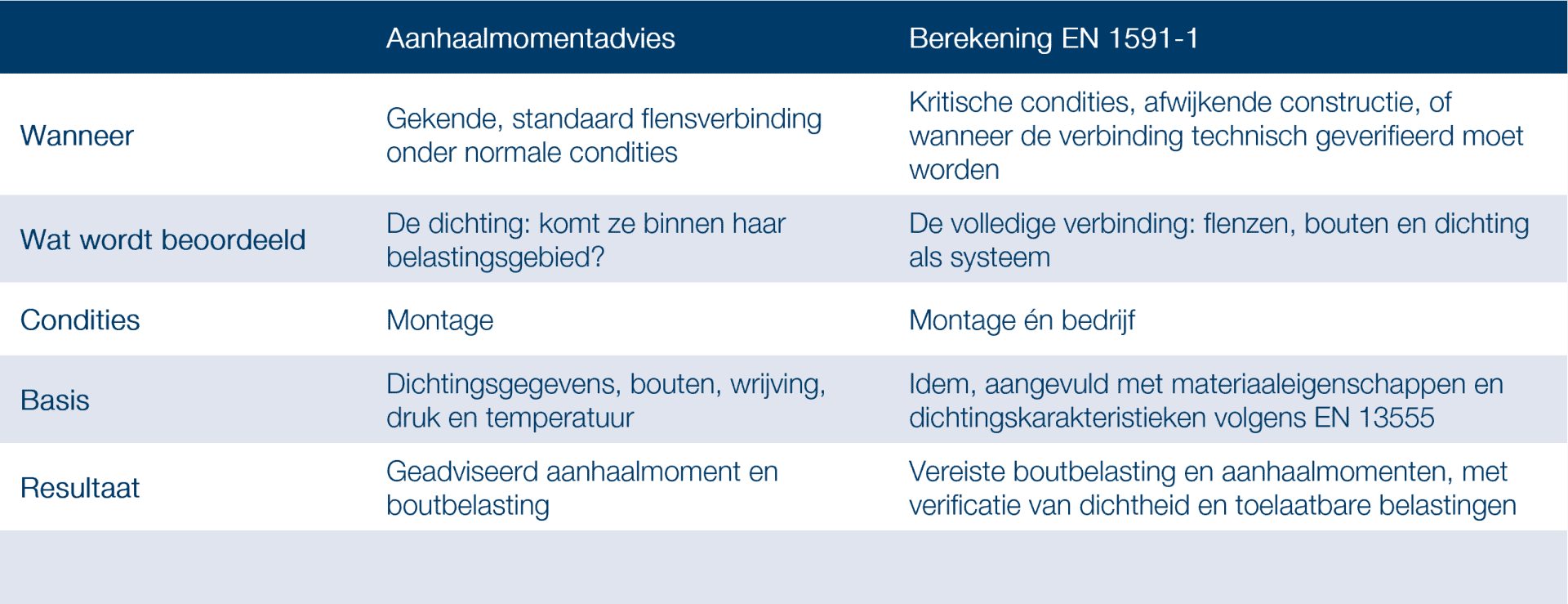
The advice is aimed at building the correct surface pressure on the gasket during assembly. It is not a full calculation of the flange connection: factors such as flange rotation and the load on flanges and bolts as a complete system are not verified here. For many regular applications, this is sufficient. For critical connections or when full technical verification is required, we recommend an extensive calculation according to EN 1591-1.
When is tightening torque advice sufficient?
It brings the gasket within the suitable load range during assembly. It is not a full strength calculation of the flange connection; flanges and bolts are not verified as a system. For known constructions under normal conditions, this is usually sufficient; for critical applications, it is not.
Flange calculation according to EN 1591-1
For critical applications or when a full assessment of the flange connection is required, we perform a calculation according to EN 1591-1.
In this process, the connection is viewed as a single entity. Not only the gasket, but also the flanges and bolts are included in the calculation, both during assembly and under operating conditions.
The calculation takes into account pressure, temperature, geometry, and the material of the flanges, bolts, and gasket. Changes in bolt and gasket load due to temperature and relaxation are also included. Where necessary, external forces and moments can also be entered.
For the gasket, we use material data according to EN 13555 to verify that sufficient surface pressure remains during both assembly and operation without overloading the gasket.
This determines the bolt load required to reliably seal the connection, while also checking that the various components remain within their allowable load limits. This results in the appropriate tightening torques.
Which of the two do you need?
Unsure which one you need?
Provide us with the details of your connection, flange type, gasket, bolts, and operating conditions, and we will advise whether a recommendation suffices or a full calculation is recommended.
Ask an expert
Ask an expert for advice; we are happy to help you!