
Every cubic meter of sludge leaving your site is largely water that you pay to transport and process. A screw press reduces that volume.
The LiberAqua LDP is a screw press with rotating discs for the dewatering and mechanical thickening of sludge.
How it works
The press has two zones. In the gravity thickening zone, the filter elements are spaced further apart, allowing the free water to drain first. In the dewatering zone, this distance gradually decreases as the pressure increases, until the sludge cake is discharged.
As a result, the press also processes thin sludge, from approximately 2 g/l, depending on the sludge properties and process conditions.
The filtration structure consists of fixed discs, moving discs, and spacers in stainless steel. Because they move relative to each other, the filter surface is continuously cleaned — this is what makes the press less susceptible to clogging than traditional filtration systems.
Flocculation
Effective dewatering depends entirely on correctly adjusted flocculation. Therefore, the LDP is supplied with an upstream flocculation tank, in which the sludge is mixed with the chosen polymer under controlled conditions.
Suitable sludge types
- Mixed sludge
- Primary sludge
- Biological sludge
- Digested sludge
- Sludge from physico-chemical processes
LDP-S for fiber-rich sludge
For sludge with a high fiber content, there is the LDP-S, featuring anti-clogging elements in the drainage. Applications include the paper and pulp industry, plastic recycling, and fiber recovery.
Automation
Standard with electrical control panel, PLC, and HMI. Depending on the configuration, the system controls the screw speed, the agitator, the sludge feed pump, the flocculant dosing, the rinsing water cycles, and the downstream discharge equipment. Frequency converters allow you to adjust the parameters to your sludge.
Advantages
- Low energy consumption due to slow-speed operation
- Limited maintenance and low noise level
- Continuous, automated operation
- Limited rinsing water consumption
- Self-cleaning filtration system
- Suitable for thin sludge and for sludge containing oils and fats
- Direct dewatering from the biological reactor is possible in suitable applications
- Reduced need for separate thickening equipment
- Available in AISI 304L or 316L
- Compact footprint
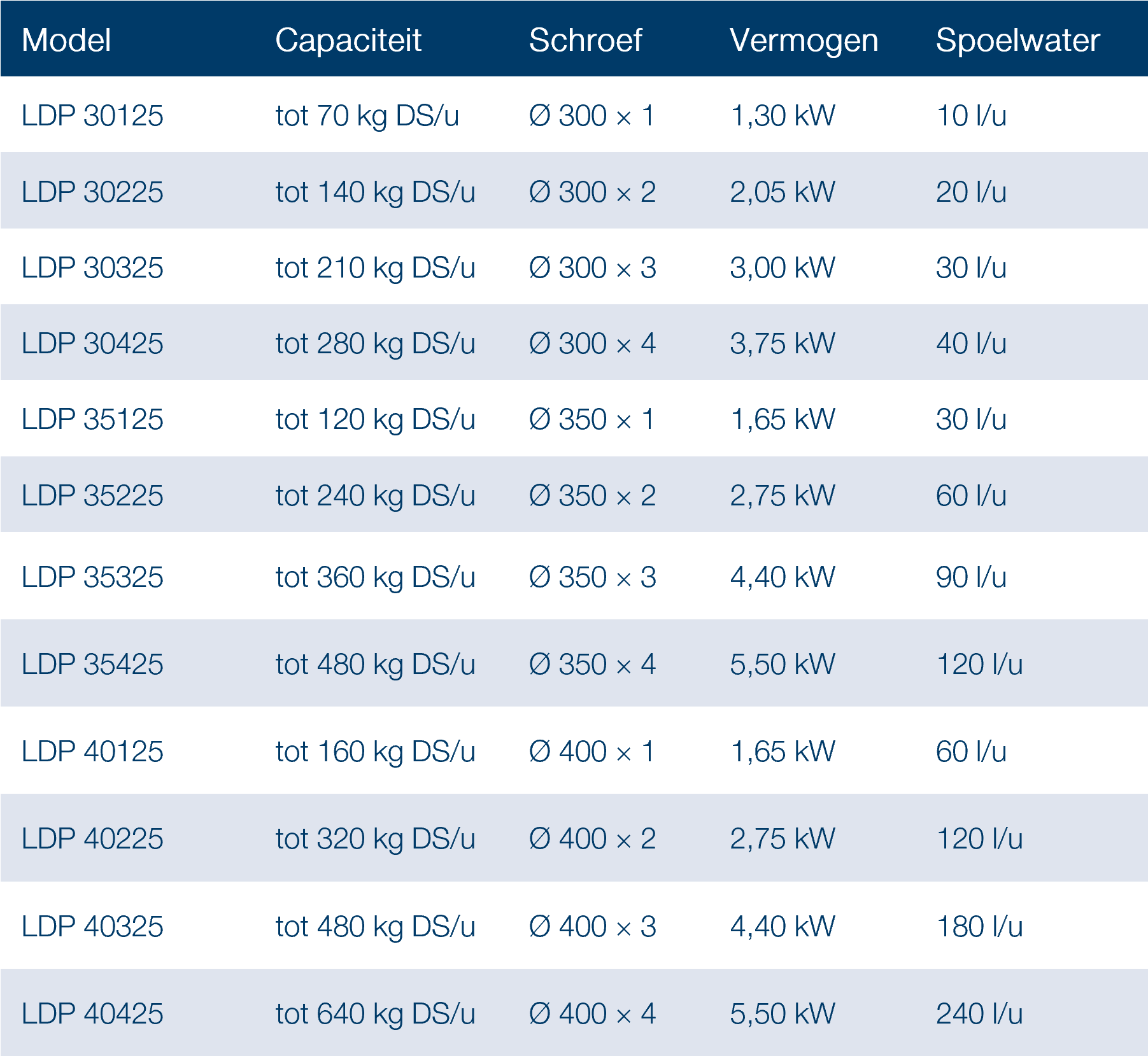
Models
Contact
Contact an expert; we are happy to help you!