
Optimize your steam system
Your production line is running. But is it running optimally?
Have the full status of your steam and condensate system mapped out with a scan: which traps are working, which are not, and what that costs per measurement point. Overhaul or replacement where necessary, prioritized by the highest return on investment.
KLINGER handles this with a project-based approach, from inspection to optimization.
Save hundreds of thousands of € annually
Suppose your company has 150 steam traps. 30% are not functioning optimally; that is 45 steam traps leaking steam.
A single leaking steam trap can easily cost €15 per day. That is over €5,500 per year. Per trap.
Multiply that, and your total steam loss—depending on system pressure—can quickly add up to tens of thousands of euros per year. Year after year, unnoticed.
New, correctly functioning steam traps are not an expense. They are an investment that pays for itself incredibly quickly.
7 consequences of malfunctioning steam traps
A defective steam trap is rarely just one problem. It is a chain
of consequences that affects your installation, your people, and your budget:
The 7 consequences:
- Dangerous working conditions due to water hammer & uncontrollable pressure build-up
- Excessive fuel consumption and unnecessary CO₂ emissions
- Corrosion in your pipes and return network
- High back pressure in the condensate network
- Accelerated wear of valves and control valves
- Unnecessary investments for condensate drainage
- And ultimately: downtime at the worst possible moment.
Why it remains unnoticed for so long
Modern steam installations are more efficient than ever. Waste heat is utilized, systems are optimized, and the boiler runs as it should.
And yet, in many of these installations, energy leaks away through steam traps that no longer perform their intended function. Usually, these are small leaks, each one too small to be noticed individually. No alarm goes off, nothing stops, and you only see a total figure on the energy bill.
The function of a steam trap is simple: as soon as steam has released its heat, the trap discharges the condensate and keeps the steam in the system. If it does not work correctly, one of two things happens. It remains open and lets live steam through. Or it becomes blocked, backing up condensate and causing water hammer.
The first costs you money. The second costs you equipment, and sometimes more than that.
The cost of a single leaking steam trap
Take a DN25 steam trap that is stuck open at 10 bar(g). It allows approximately 12 kg of steam per hour to escape.
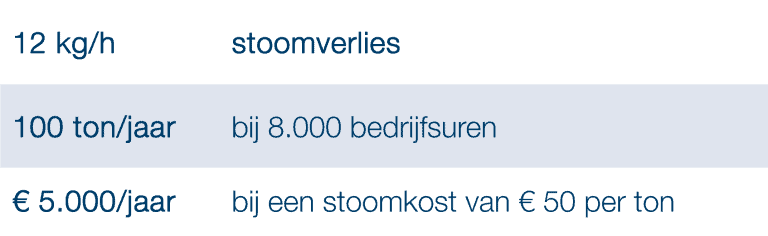
For one trap. Which you don’t hear, don’t see, and which doesn’t generate a fault anywhere.
And it doesn’t stop at the energy bill. Higher steam demand means more fuel, and more fuel means higher CO₂ emissions. Three problems with one cause.
And on the scale of an installation
Suppose you have 150 steam traps and thirty are not working as they should. That is one in five.
Not every one of those thirty leaks steam; a trap that is blocked backs up condensate and causes damage instead of loss. But for the traps that are stuck open, the bill adds up to tens of thousands of euros per year. Year after year, without being recorded as an expense anywhere.
In this context, new, correctly working steam traps are not an expenditure but an investment. With long operating hours and higher system pressure, they typically pay for themselves within a year.
Our advice
Inspect your steam traps annually and replace them where necessary.
This is the simplest intervention possible to keep a steam installation reliable, safe, and cost-efficient. No redesign, no weeks of downtime, no complex investment case.
Crucially: a steam trap should be assessed by measurement, not by feel. A trap that feels warm may be functioning perfectly. A trap that looks pristine may be completely open. Without ultrasonic or temperature measurement, you simply don’t know.