
A DN100 valve with a surface temperature of 180 °C radiates approximately 1.2 kW. With 8,000 operating hours and a heat cost of €0.06/kWh, that is about €580 per year. Per valve. And there is rarely just one.
Why a valve is different from a pipe
Pipes are almost always insulated. Valves are not, and there is a reason for that: you need to be able to access them. Fixed insulation must be broken off during every inspection or overhaul, so it often simply stays off.
The result is that the unprotected surface is larger than people think. A valve has a valve body, a bonnet, two flanges, and a stem, all hot and all in contact with the ambient air. In a well-insulated steam network, the valves can therefore represent the largest remaining loss.
What it costs per year
The table below shows the estimated annual energy cost of one uninsulated valve. Assumption: 20 °C ambient temperature, 8,000 operating hours per year, and a heat cost of €0.06/kWh.
Annual energy cost per uninsulated valve, in euros.
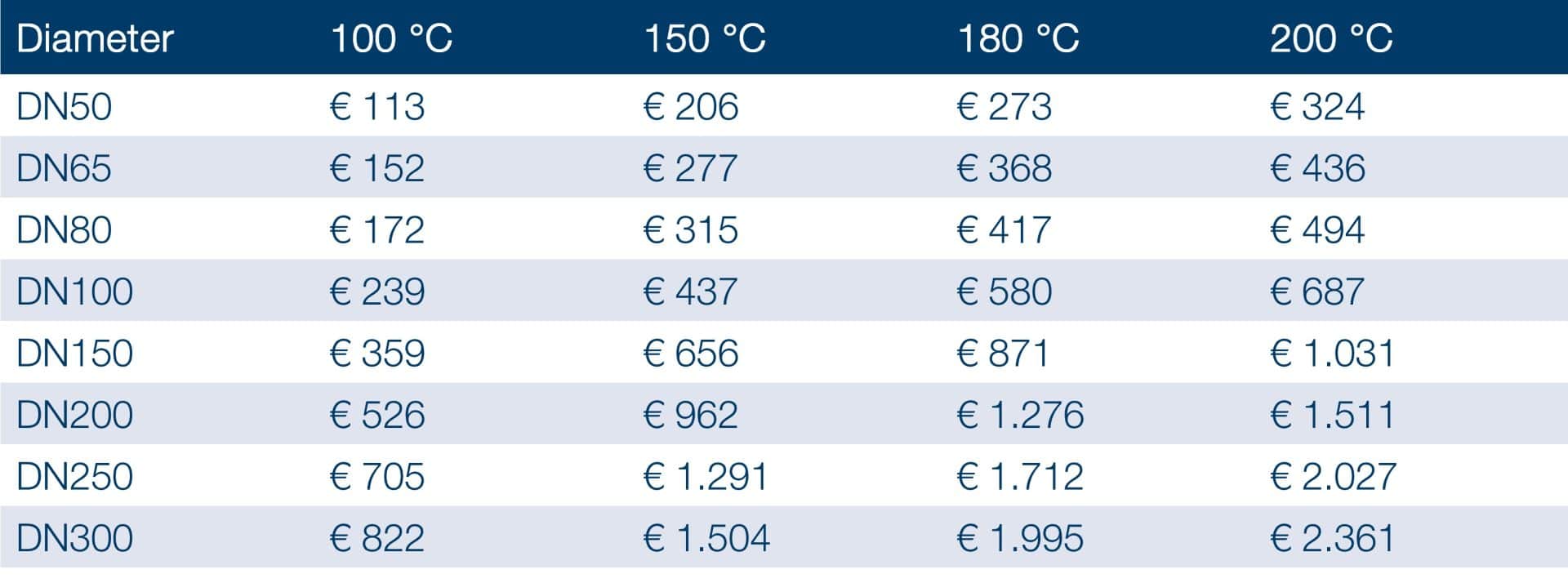
Note the jump in temperature. Between 100 °C and 200 °C, the cost almost triples, while the temperature difference with the environment only slightly more than doubles. This is due to thermal radiation, which increases with the fourth power of the absolute temperature. The hotter the valve, the faster the insulation pays for itself.
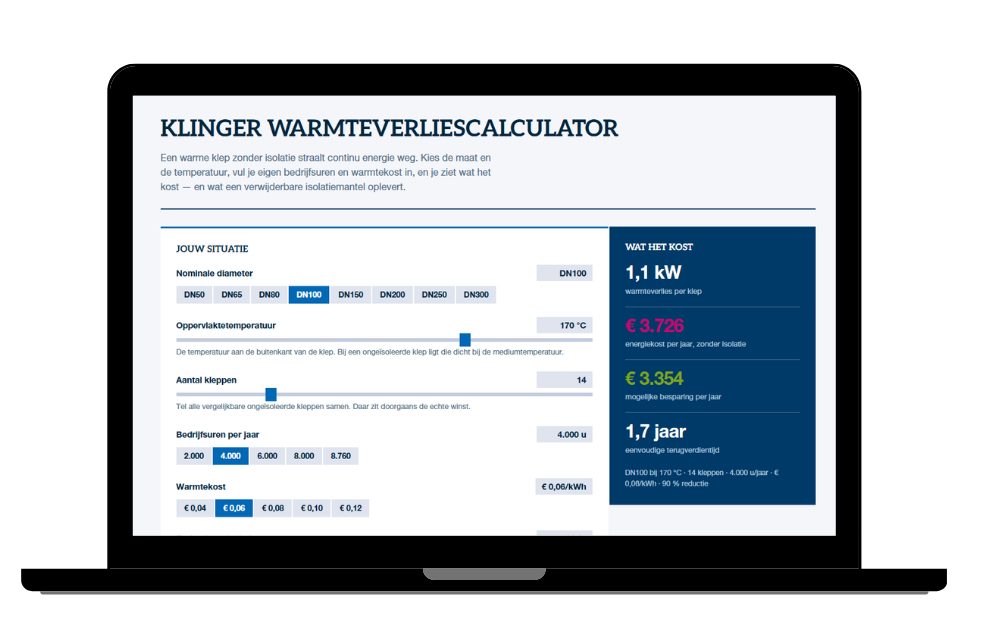
Calculate it for your own installation
Enter your diameter, temperature, operating hours, and heat cost, and immediately see the savings and the payback period. Here goes your text … Select any part of your text to access the formatting toolbar.
Why a removable jacket
A removable insulation jacket solves exactly the problem of why valves remain unprotected. It goes around the valve with clamps or straps and can be detached in minutes.
- Remains removable for inspection, maintenance, and overhaul
- You don’t have to break off insulation and have it reapplied afterwards
- Reusable after the valve is reinstalled
- The underlying surface remains visible, making it easier to detect corrosion under insulation early
- Lowers the surface temperature, which also limits the risk of contact for your personnel
Where the greatest gain lies
Not every valve is equally interesting. These four factors determine where you start:
- Surface temperature. Above 150 °C, the loss increases rapidly.
- Operating hours. A valve in continuous operation loses four times as much as a valve operating in a two-shift system.
- Diameter. From DN100 onwards, the amount per valve becomes substantial.
- Quantity. Twenty DN100 valves at 180 °C represent more than €11,000 per year.
From heat loss to payback period
The calculation is simple. Take the annual cost from the table, multiply by the number of valves, and calculate with the reduction achieved by the jacket. Divide the investment by the annual savings and you have the simple payback period.
At high temperatures and long operating hours, this payback period is often less than one year. This is an investment that pays for itself within one fiscal year and continues to yield returns thereafter, which significantly simplifies the conversation with the financial manager.
Frequently asked questions
-
How do I measure the surface temperature?
With an infrared thermometer or a contact thermometer on the valve body, not on the flange or the stem. Measure at a location that is representative of the majority of the surface. For an uninsulated valve, the surface temperature is usually close to the medium temperature.
-
How much heat loss does a jacket remove?
That depends on the jacket thickness, the insulation material, and especially on the finish around the stem and flanges. For an initial estimate, 90% is often used. The actual value depends on the jacket design you choose.
-
Can a jacket be used on any valve?
On almost any valve, but it is custom-made for each valve. Therefore, we need the valve type, the DN, the pressure class, and a photo or measurement, including the connections. The environment also matters: outdoors or in a wet room requires a different outer layer.
-
What about corrosion under insulation?
This is a real point of concern with fixed insulation in the temperature range around 60 to 120 °C, where moisture can condense. A removable jacket has an advantage here: you can open it and inspect the surface without destroying anything.
Have it measured
Our technicians measure the surface temperatures, map out the uninsulated valves, and draw up a priority list: which valves first, and what the payback period per unit will be.
Schedule a meeting with an expert

Related expertise
What is the cost of a steam leak?
At 5 bar(g), a 3 mm leak loses over 170 tons of steam per year. Calculate what a steam leak costs you and what to look for during a walkthrough.
Custom insulation jackets
Stopping heat loss where insulation is missing
On-site support
On-site troubleshooting, audits, product advice, and training.
Waste heat recovery
Optimal use of heat energy through recovery.
*Simplified heat balance for natural convection and thermal radiation at 20 °C ambient temperature. The valve surface areas used follow the published ASTM C1129 table for Class 150 as an order of magnitude. Actual values vary by valve type, pressure class, geometry, airflow, and jacket design. Intended as a commercial initial indication, not as a guaranteed saving.