
From energy consumption to human rights: ESG rules guide our actions. Yusuf Avci, Sustainability Manager at KLINGER Holding, explains how KLINGER handles the new sustainability requirements.

As ESG Manager of KLINGER Holding, Yusuf Avci will henceforth oversee the group's sustainability data.
Mr. Avci, we are increasingly hearing terms like ESG, CSRD, EU Taxonomy, and so on. What do these rules mean for the KLINGER Group?
Yusuf Avci: The new requirements demand detailed and comparable sustainability data. From 2026, we must report on each preceding financial year. In addition to traditional financial key figures, these reports must also include our energy consumption, waste volumes, personnel figures, and CO₂ emissions. In short: customers, investors, and regulators expect transparency.
How is KLINGER dealing with all these different directives and regulations?
Yusuf: We are dealing with various regulations, such as the Corporate Sustainability Reporting Directive, the EU Taxonomy, and the Corporate Sustainability Due Diligence Directive. Each of these requires different documents and data. As a manufacturing company, it is crucial that we include all our locations. The lack of a single standardized ERP system presents a challenge in this regard. We are currently collecting data based on SIC codes and gaining experience through a GHG pilot project involving KLINGER Finland, KLINGER Fluid Control, KLINGER Dichtungstechnik, and KLINGER Gebetsroither. The goal is to develop standards that allow us to comply with all regulations.
What can we conclude from the final ESG report?
Yusuf: The report covers, among other things, energy consumption and intensity, waste management and reduction, recycling and the circular economy, water consumption and water management, reduction of raw material use and material efficiency, resource scarcity, and risk management. Where can we reduce waste and where are new strategies for greater sustainability emerging? Personnel development and training, retention and turnover, age diversity within the team, transparency regarding the gender pay gap, the availability of grievance mechanisms, anonymity, and data protection are also important indicators for the KLINGER Group. The goal is to derive concrete measures from this. Whether it concerns more energy-efficient systems or switching to materials from sustainable sources: the ESG report provides us with a solid data foundation. This allows us to demonstrate that we meet legal requirements and actively contribute to a sustainable future.
Thank you for your insights.
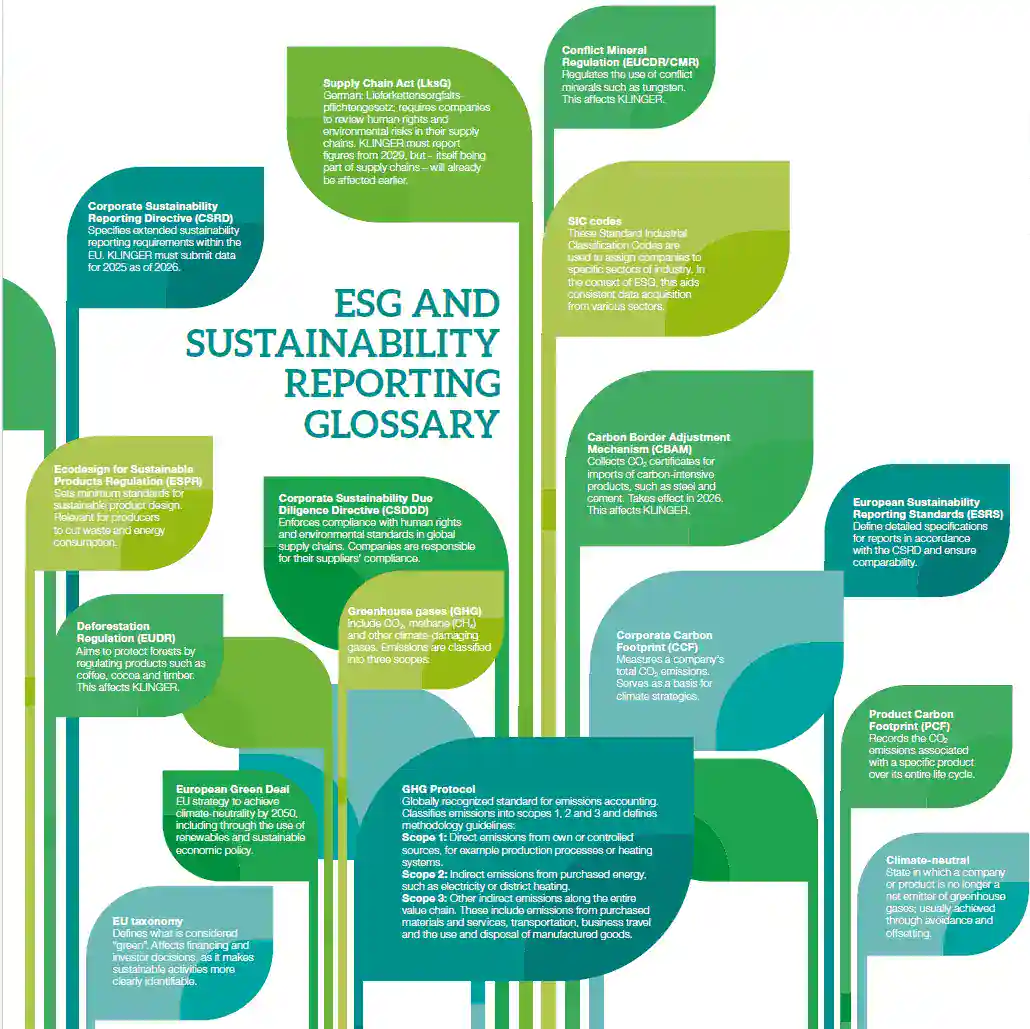
Fact box
Glossary of ESG & Sustainability Reporting
-
Climate neutral: A state in which an organization or product causes no net greenhouse gas emissions, typically achieved through emission reduction and offsetting.
- Conflict Minerals Regulation (EUCDR/CMR): EU regulation governing the use of conflict minerals such as tungsten. Applicable to KLINGER.
- Corporate Carbon Footprint (CCF): The total greenhouse gas emissions of an organization, expressed in CO₂ equivalents.
- Corporate Sustainability Due Diligence Directive (CSDDD): EU directive requiring companies to respect human rights and environmental standards in their global supply chains.
- Corporate Sustainability Reporting Directive (CSRD): EU directive mandating comprehensive sustainability reporting. KLINGER must report from 2026 onwards regarding the 2025 financial year.
- Deforestation Regulation (EUDR): EU regulation combating deforestation by regulating products such as coffee, cocoa, and wood. Relevance to KLINGER: present.
- Ecodesign for Sustainable Products Regulation (ESPR): EU regulation setting minimum requirements for sustainable product design, aimed at waste reduction and energy efficiency.
- European Green Deal: EU strategy to achieve climate neutrality by 2050, including through renewable energy and sustainable economic policies.
- European Sustainability Reporting Standards (ESRS): Detailed standards determining the content and structure of sustainability reports according to the CSRD.
- EU Taxonomy: EU classification system determining which economic activities are considered sustainable, influencing financing and investment decisions.
- Greenhouse Gases (GHG): Gases such as CO₂, methane (CH₄), and nitrous oxide (N₂O) that contribute to the greenhouse effect.
- GHG Protocol: International standard for measuring and reporting greenhouse gas emissions, divided into three scopes:
- Scope 1: Direct emissions from owned or controlled sources.
- Scope 2: Indirect emissions from purchased energy.
- Scope 3: Other indirect emissions in the value chain, such as transport and use of products.
- Product Carbon Footprint (PCF): The total greenhouse gas emissions associated with a product throughout its life cycle.
- SIC Codes: Standard Industrial Classification codes that categorize companies into sectors, useful for consistent ESG data collection.
- German Supply Chain Due Diligence Act (LkSG): German law requiring companies to identify and address human rights and environmental risks in their supply chains. KLINGER must report from 2029, but is affected earlier as part of supply chains.